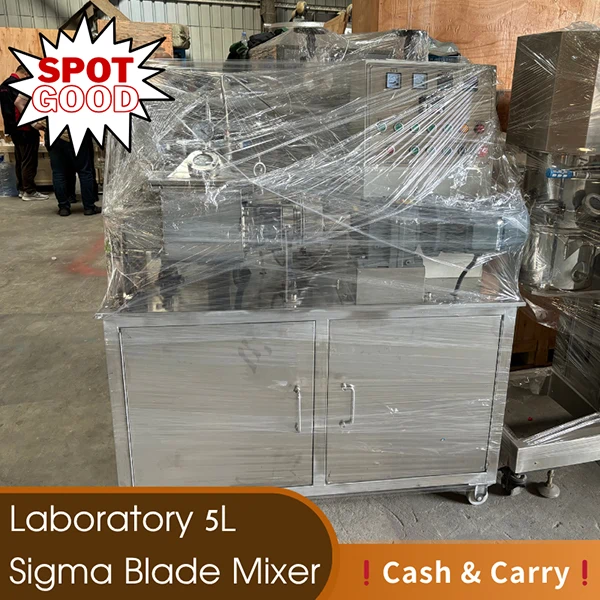
| Cylinder Capacity |
Full capacity ~ 6L |
| Discharge Method |
Hydraulic tilting discharge |
| Motor Power |
1.5KW - 6-pole standard motor |
| Gear Reducer |
Helical gear reducer |
| Inverter |
1.5KW frequency inverter |
| Cylinder Body |
W-shaped, inner cylinder wall thickness 4mm, material SUS304 stainless steel, with a 5mm heating jacket, the jacket has multiple sets of flow guide plates, material carbon steel, with material and hot oil temperature measurement |
| Wall Panels |
12mm Q235 carbon steel + 3mm SUS304 stainless steel plate, integrally bored shaft hole with the cylinder body to ensure concentricity of the stirring paddle |
| Stirring Shaft |
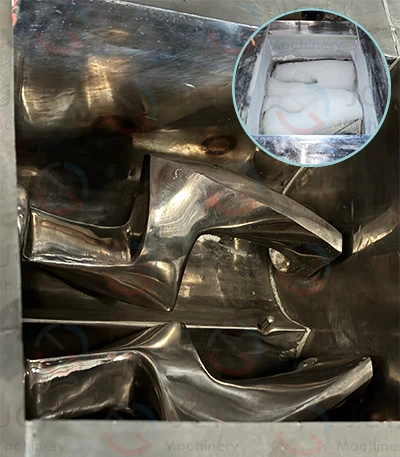
Σ-shaped, optimal streamlined structure. The impeller body is made of cast steel, rough-machined, then encased in SUS304 stainless steel, and finally precision-machined. The shaft seal is ground, and the impeller surface is polished to ensure a smooth finish |
| Shaft Seal |
Packaging seal structure, using F4 packing to ensure no black particles from packing wear enter the cylinder, guaranteeing material purity |
| Cylinder Head |
Equipped with one feed, vacuum, and vent pipe, made of SUS304 stainless steel |
| Hydraulic Cover Opening |
Opening angle ≥75° |
| Hydraulic Cylinder Tilting |
Tilting angle ≥95° |
| Heating Method |
Jacketed electric heating |
| Vacuum degree |
≥-0.095MPa |
| Heating temperature |
Room temperature - 300°C (can be cooled) |
**Contact our engineer to schedule a free laboratory 5L sigma blade mixer trial: +86-181 3837 3963 (Whatsapp, Wechat), sigmamixer@outlook.com.
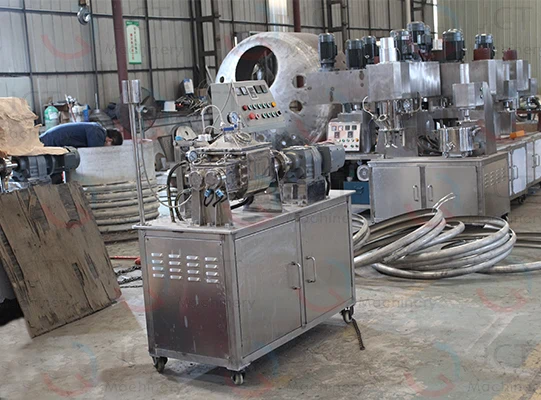
Core Technological Advantages of Laboratory 5L Sigma Blade Mixer
1. Exceptional Shear Precision and Mixing Uniformity
Laboratory 5L sigma blade mixer typically employs ∑-shaped blades, wherein the clearances—both between the blades and the mixing cylinder walls, and between the blades themselves—are maintained within an extremely tight tolerance (typically ranging from 2mm to 4mm).
- This high-precision clearance ensures that the material within the small-volume chamber is subjected to intense and uniform shearing, extrusion, and kneading forces, thereby preventing localized reaction inconsistencies within the experimental sample.
- It guarantees that the formula data generated in the laboratory can serve directly as a reliable reference benchmark for industrial-scale mass production.
2. Precision Temperature Control System
- Jacket design: Laboratory 5L sigma blade mixer is typically equipped with a fully enclosed jacket, supporting electric heating, oil-circulation heating, or water cooling.
- Direct temperature measurement: Sensors are typically inserted directly into the interior of the cylinder to capture real-time changes in material temperature.
- Technical specifications: High-performance equipment can maintain temperature control accuracy within ±1℃, effectively preventing the material from coking or degrading due to localized overheating.
3. Exceptional Vacuum Retention and Sealing Performance
For experiments requiring dehydration, degassing, or operation under an inert gas atmosphere, effective sealing is a critical lifeline.
- Shaft sealing technology: Employs a combination of mechanical seals and packing seals—or alternatively, self-lubricating composite seals—to ensure leak-free, long-term operation under a negative pressure of -0.098MPa.
- Contamination prevention: High-end models feature a non-contact bearing design to prevent lubricant oil from seeping into the process materials, thereby safeguarding the purity of the experimental samples.
4. Intelligent Data Acquisition and Monitoring
This constitutes the most significant distinguishing feature of this experimental-grade equipment compared to standard production machinery.
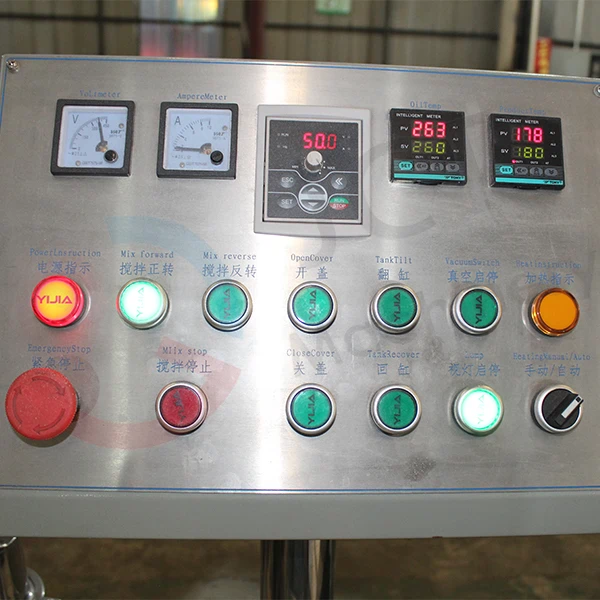
- Real-time torque monitoring: The system displays and records the torque variation curve during the mixing process in real time.
- Formula storage: The system is capable of storing multiple formulas, allowing for one-touch retrieval. Recipes can be saved in an encrypted format.
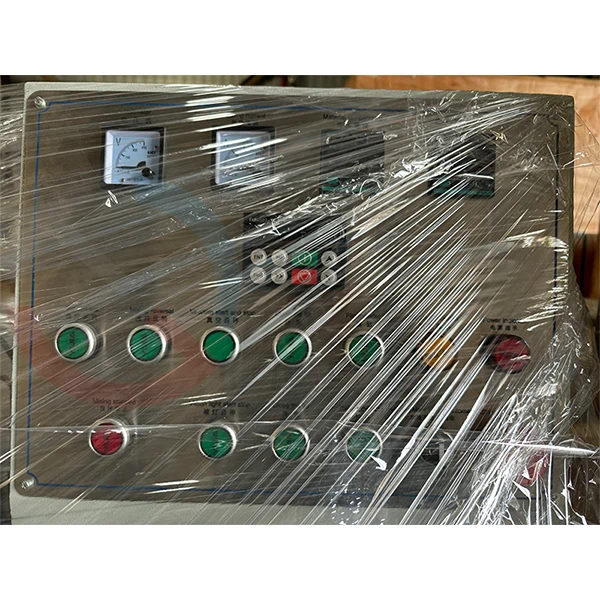
- Digital interface: Equipped with a PLC touchscreen, the system supports USB data export, facilitating subsequent scientific analysis on a computer.
5. Easy-to-Clean Design
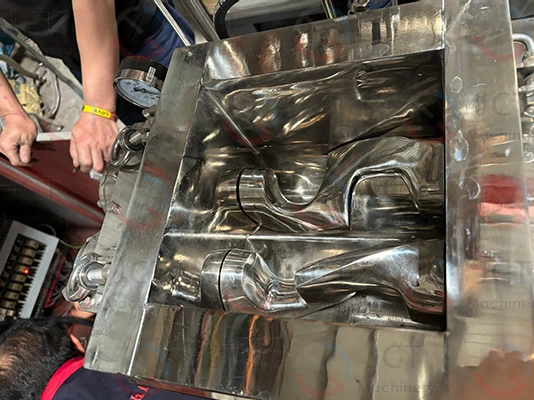
- Mirror polishing: The blades and interior of the cylinder undergoes a mirror-polishing treatment to achieve a surface roughness of Ra < 0.4μm. This significantly reduces material adhesion to the walls, making cleaning simple and rapid, and effectively eliminating cross-contamination between batches.
Laboratory 5L Sigma Blade Mixer Applications Across Multiple Fields
- High-viscosity adhesives: R&D of glass adhesives, silicone rubber, and sealants.
- New materials & energy: Battery slurries and ceramic powder compounding.
- Chemicals & pharmaceuticals: Ointments, cosmetics, hot melt adhesives, and resin synthesis.






 Home
Home